What the model said, what the meter said
The coefficient falls as the flow temperature rises
A heat pump's rated COP is measured at a specific test condition, and the number on the brochure is not the number in the building.
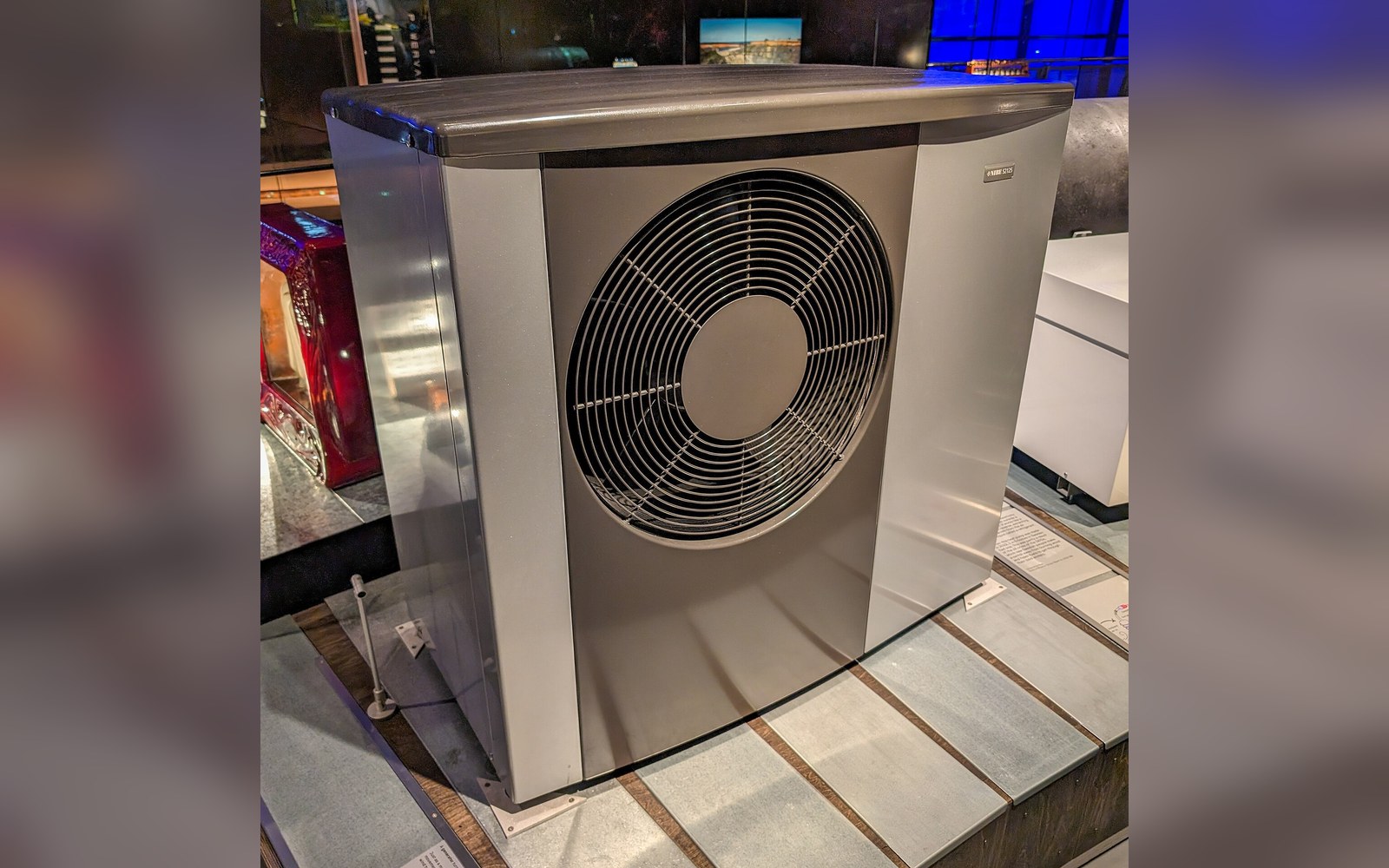 PLATE 01
The unit is half the answer. What it is asked to heat the water to decides what it returns.Photo: NIBE S2125 air source heat pump (front) - Science Museum, London · Wikimedia Commons
The physics is not negotiable
Every heat pump — whether air-source or ground-source — moves heat by exploiting the temperature difference between a source and a sink. The smaller that difference, the less work the compressor does for each unit of heat delivered, and the higher the coefficient of performance (COP): the ratio of heat output to electrical input. Widen the gap and the COP falls. This is not a quality issue or a manufacturing variable; it is thermodynamic law, and the Carnot limit sets the ceiling regardless of refrigerant or compressor design.
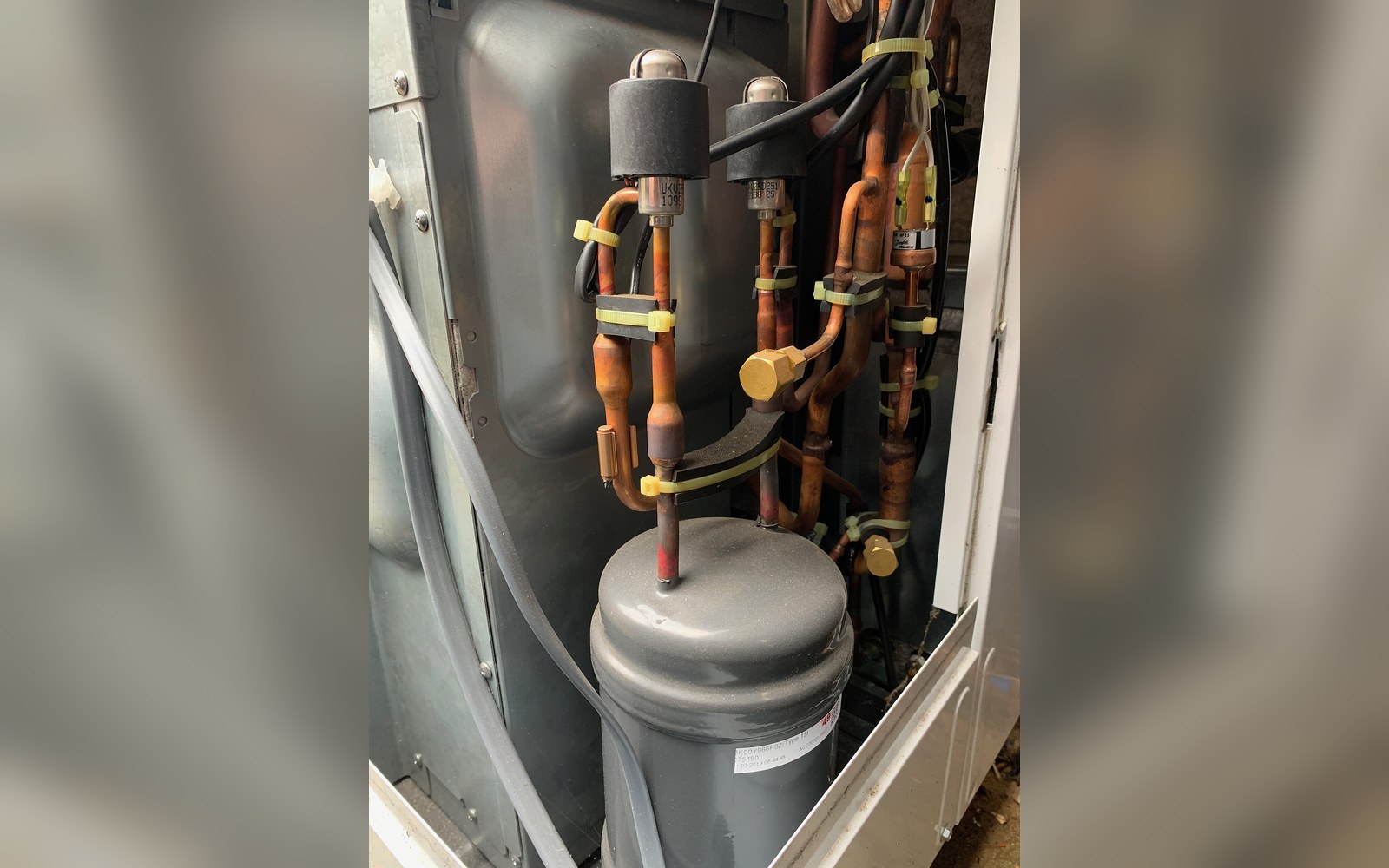 PLATE 02
Inside the casing: the flow and return that fix what temperature the emitters can be run at, and with it the coefficient.
Photo: Ecodan outdoor unit Internal view · Wikimedia Commons
The European test standard EN 14511 measures heat pump performance at defined operating points — typically an outdoor air temperature of 7 °C and a flow temperature of 35 °C for air-to-water machines. That is where the headline COP is produced: somewhere between 3 and 5 for most residential units. Raise the flow temperature to 55 °C, and the same machine will typically see its COP drop by roughly a third. At 70 °C — the territory of a conventional boiler circuit — many units are operating at a COP below 2, at which point the case for using one rather than a direct-resistance heater narrows sharply.
But SCOP is still a modelled figure, calculated against a reference climate.
The emitters are not a detail
This is why the heat distribution system matters as much as the heat pump itself. A radiator sized for a 70/50 °C flow/return regime running at 45/35 °C will not deliver the same output, because radiator output scales approximately with the mean water-to-room temperature difference raised to a power of around 1.3. Undersized emitters force a higher flow temperature; a higher flow temperature collapses the COP. The arithmetic closes on itself.
A meter and a modelled output on the same table — the two figures the performance gap is the distance between.
Underfloor heating typically operates at 35–45 °C flow and is a natural match for heat pump operation. Existing radiator systems vary enormously — a well-oversized Victorian cast-iron radiator may perform adequately at lower flow temperatures; a 1980s panel radiator sized to the minimum may not. The only way to know is to calculate the actual output at the proposed flow temperature, which requires knowing the emitter's rated output and the temperature differential it will see. Design assumptions here have a direct, measurable effect on seasonal performance.
The Seasonal Coefficient of Performance (SCOP), now the primary regulatory metric in most European frameworks, attempts to capture this by integrating performance across a range of operating conditions over a full heating season. But SCOP is still a modelled figure, calculated against a reference climate. Measured in-situ performance routinely diverges from it — a pattern well-documented in the performance gap between designed and delivered building energy use.
What the metering shows
Field data from the UK's Heat Pump Field Trials, published by the Energy Saving Trust and later by the Electrification of Heat project, recorded mean SPFs (Seasonal Performance Factors — the measured equivalent of SCOP) across hundreds of installations. The spread was wide: some systems achieved SPFs above 3.5, others fell below 2. Flow temperature was consistently one of the strongest predictors of where a system landed in that range. Installations with mean flow temperatures below 45 °C performed significantly better than those running at 55 °C and above.
The practical implication is that the performance gap for heat pumps is not principally a problem of the heat pump. It is a problem of what the system around it is asked to do. An undersized emitter circuit, a poorly insulated building demanding high output, or a domestic hot water cylinder requiring legionella-prevention cycles at 60 °C — each of these pushes the operating point up the temperature scale and the COP down the performance curve.
The coefficient of performance is real, but it belongs to a system, not a product. The number on the brochure was measured elsewhere, in different conditions, answering a different question.
Read next