What the model said, what the meter said
How cold the outside is, county by county
Degree days are how a heating demand is normalised, and without them two buildings cannot be compared.
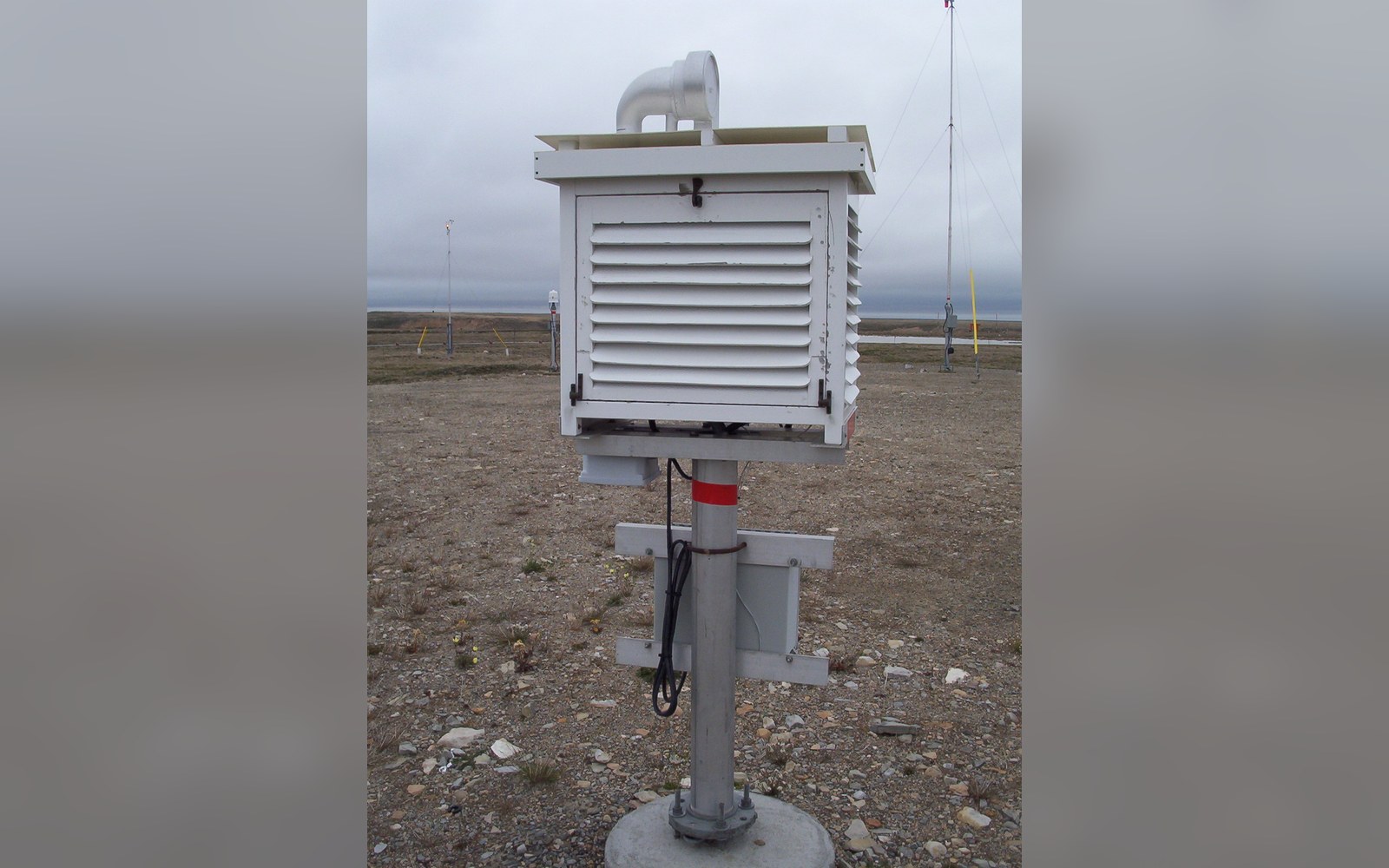 PLATE 01
A screened instrument enclosure: degree days start as air temperature recorded to a standard exposure.Photo: Stevenson screen exterior · Wikimedia Commons
What a degree day measures
A building in Aberdeen and a building in Exeter may have identical insulation, identical air-tightness, identical occupancy — and the one in Aberdeen will still burn through more fuel. That difference is not a performance gap; it is geography. Separating the two requires a common currency, and that currency is the degree day.
The idea is straightforward. Take a base temperature — conventionally 15.5 °C for space heating in the UK, a figure chosen because internal gains from people, lights and appliances are assumed to make up the remaining gap to a comfortable 18 °C — and subtract each day's mean outdoor temperature from it. A day where the outdoor mean is 5.5 °C contributes ten degree days. A day above the base contributes nothing: the heating system is assumed to be off. Sum those daily figures across a month or a year and you have a number that describes, in a single integer, how demanding a location's climate is for a heated building.
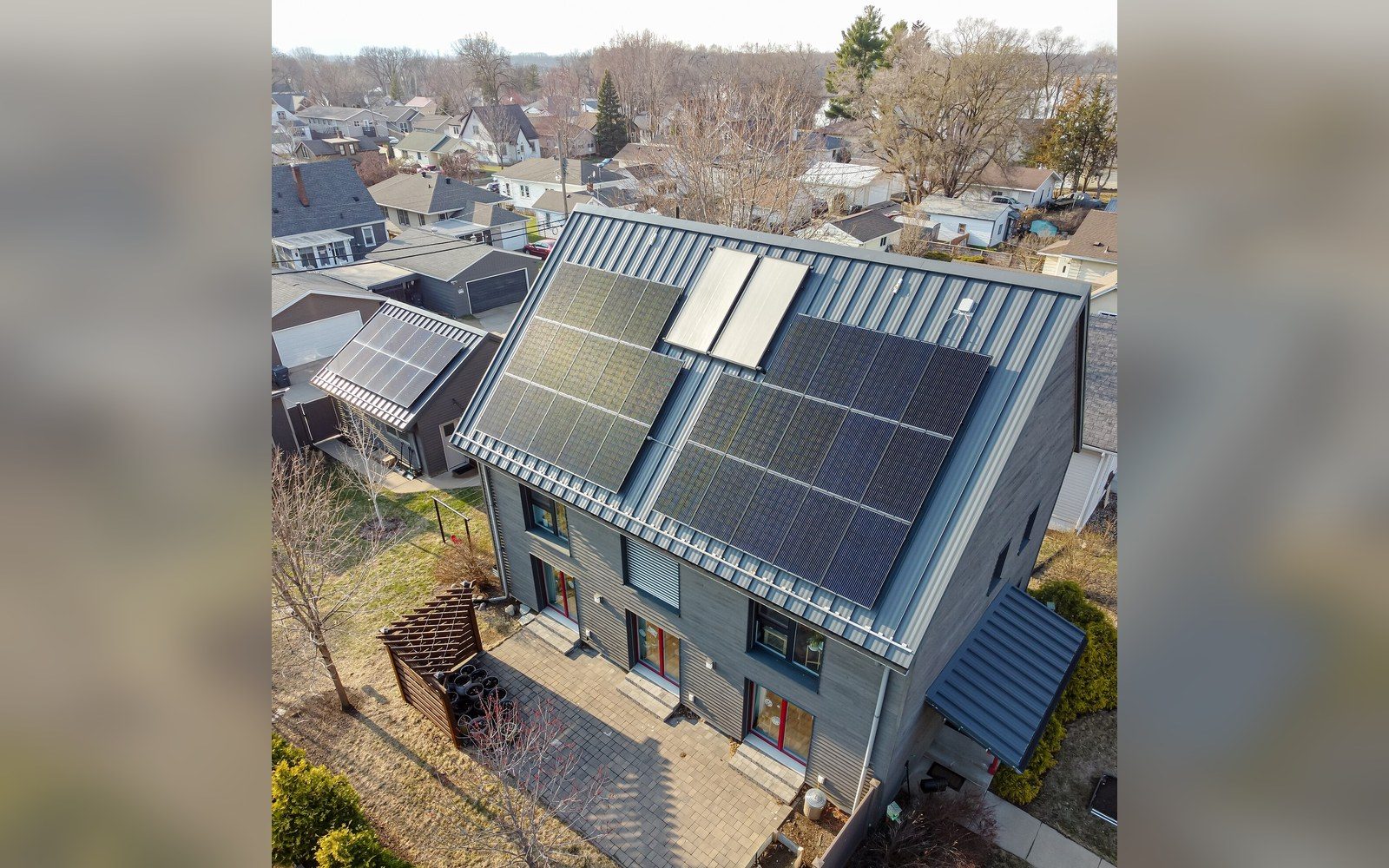 PLATE 02
Certification rests on measured criteria, which is the only reason the standard can be certified at all.
Photo: Passive house in La Crosse · Wikimedia Commons
The Meteorological Office (now the Met Office) was calculating regional degree-day figures for the UK from the mid-twentieth century. Today, CIBSE's degree-day data is published by region, and independent services aggregate station data to produce county-level series going back decades. The UK is divided into twenty standard regions for this purpose, running from Thames and Severn in the south to Scotland and Northern Ireland in the north — a coarse grid, but one fine enough to reveal differences that matter.
The county-by-county variation
The spread across England alone is considerable. A site in Cornwall typically accumulates around 1,900 heating degree days in a year (base 15.5 °C); a site in the North Pennines may see closer to 3,000. Scotland's west coast runs higher still, compounded not just by temperature but by the frequency of overcast days suppressing solar gain. Coastal locations benefit from the sea's thermal inertia, which moderates both summer and winter extremes; inland and elevated sites do not.

A meter and a modelled output on the same table — the two figures the performance gap is the distance between.
This variation has a direct bearing on how heating demand is interpreted. A poorly insulated terrace in Truro and a well-insulated semi-detached in Leeds might return similar metered energy figures, but normalising by degree days ↗ immediately exposes that the Leeds house is performing much better per unit of climate demand. Without that normalisation, the terrace looks no better than it is, and the semi-detached looks no worse. Benchmarking collapses into noise.
The same logic underlies the performance gap literature. Studies comparing modelled to metered consumption — the kind that revealed systematic under-performance in UK housing — normalise their measured data to a standard year before drawing conclusions. If they did not, a run of mild winters would make a badly built estate look acceptable, and a cold year would make a good one look profligate.
Coastal locations benefit from the sea's thermal inertia, which moderates both summer and winter extremes; inland and elevated sites do not.
Degree days in practice
Degree days also interact with the other quantities that characterise a building's thermal behaviour. The fabric heat loss coefficient — units of watts per kelvin — multiplied by annual degree days (converted to kelvin-hours) gives a first approximation of annual space heating demand through the fabric alone. Ventilation and air infiltration losses are added separately, and internal and solar gains subtracted. The degree-day figure is the environmental input on which the rest of the calculation runs; get it wrong, or ignore it, and every subsequent number drifts.
One subtlety worth noting: the conventional base of 15.5 °C assumes a fixed internal gain that may not hold. A low-energy building with good fabric and minimal occupancy may need heating on fewer days than a conventional building, pushing its effective base temperature lower and reducing its degree-day count relative to published regional figures. The Passivhaus Institut ↗ addresses this by using dynamic simulation rather than degree days alone, precisely because at very low heat-loss coefficients the assumption of constant internal gain breaks down.
Degree days are not a perfect instrument. But as a way of asking how hard was this building's climate working against it?, they remain the most practical tool in common use — and the one that makes county-by-county comparisons honest.
Read next